Source
- Cloherty and Stark’s manual of neonatal care
definition
one or more of the following of
- Poor central or peripheral pulses
- tachycardia
- mottled appearance
- pale color
- prolonged CRT (>3 sec)
- core-periphery difference of 3o C
- low blood pressure
Additional features includes (to strengthen the diagnosis)
- urine output <0.5 ml/kg/hour in the last 6 hours
- serum lactate >5 mmol/L
- low PH (<7.25)
- base deficit of >-5mEq/L
Hypotension in neonates
- Mean blood pressure less than 5th percentile for the postnatal age in days
- British Association of perinatal medicine - working Definition MBP less than gestational age or <30 mm Hg whichever is higher
- MPB of 20 mm Hg isacceptable if CrCP (Cerebral critical closing pressure) is maintained - undermines the importance of organ perfusion rather than blood pressure alone
- Bedside capnography can be a surrogate marker for organ perfusion
Classification of neonatal shock
4 types irrespective of the etiology
| features | type of shock |
|---|---|
| low CO + normal BP | compensated shock |
| low CO + low BP | decompensated shock |
| normal to high CO + low BP | hyperdynamic shock |
| normal CO + low BP | transitional circulation |
Assessment of circulation
clinical signs
- pulses - especially femoral and brachial pulses
- heart rate - tachycardia denotes early phase of shock
- capillary refill time - unreliable in hypothermia, rapid CRT may denote septic shock
- cold peripheries - core-peripheral difference of 3o C
- SpO2 - pre-post ductal difference of 3%
Blood pressure
- Systolic BP - myocardial contractility
- Diastolic BP - basal vascular tone, low blood volume
- cuff width to arm ratio should be between 0.45 - 0.55
- invasive BP(iBP) can be considered in extremely low birth weight babies as oscillometric method can overestimate BP if MBP is less than 25 mm Hg
- in iBP, dampening of waveform can happen which can be due to introduction of air bubbles or use of small depth catheters
- it can under-read systolic and over-read diastolic pressures
Echo
- various parameters of echo helps in the assessment of shock
| parameter | inference | Cut-off for abnormality | Caveats |
|---|---|---|---|
| IVC collapsibility | IVC collapsibility | IVC collapsibility | IVC collapsibil |
| Left ventricular output | systolic function and contractility | < 150 ml/kg/min | affected by PDA shunt |
| Right ventricular output | systolic function and contractility | < 150 ml/kg/min | affected by ASD / PFO |
| ejection fraction | systolic function and contactility | - 41-55% (mild reduction) - 31- 40% (moderate) - < 30% (severe) | affected by preload and after laod |
| shortening fraction | systolic function and contactility | < 25% to sd | affected by preload and after load |
| superior vena cava flow | cerebral blood flow return (surrogate for organ blood flow) | < 40 ml/kg/min in first 24-48 hrs | difficult to measure Only measure cerebral blood flow |
other methods of assessment
- chest x ray -helpful to diagnose cardiomegaly, pulmonary oligemia or plethora, pleural effusion, pneumothorax
- ECG - to diagnose myocardial injury and structural heart diseases
- Perfusion index (PI) - ratio of pulsatile and non-pulsatile blood flow
- plethysmograph variability index - derived from PI reflecting its dynamic change during one respiratory cycle
- Electrical bio-impedance and bio-reactance - continuous cardiac output measurement by measuring electrical impendence over thorax
- cerebral and somatic oxygenation ( near infra-red spectrometry)
Causes of shock
sepsis perinatal asphyxia left to right shunt
sepsis and shock
- vasodilation and vasoparesis leading to capillary vascular leak
- initially can be compensated with increased heart rate
- LV contractility deteriorate quickly with increase in SVR, leading to compromised blood flow, MODS and death
features of septic shock
- low DBP and hyperdynamic left ventricle in early stages
- low SBP in late stages
- state of relative adrenaline insufficiency (RAI)
- < 5 μg/dL of plasma cortisol is suggestive of adrenocortical insufficiency
- <15 μg/dL in a stressed neonate is suggestive of RAI
Diagnosis of shock
- confirmed sepsis - blood culture or sepsis screen positive
- Probable sepsis - blood culture and sepsis screen negative, but strongly suggestive of sepsis like sclerema or refractive metabolic acidosis
Perinatal asphyxia
- shock in initial 48 hours due to myocardial ischemia
- reduced stroke volume and low SBP,
- mimics
- cardiogenic shock - arrhythmias, cardiomyopathy
- pneumothorax, pleural effusion
Management of shock
Management of early signs of shock
- TABC - Temperature, airway, breathing and circulation
- administer antibiotics in the 1st hour if sepsis is suspected
- initial administration of 10 ml/kg of 0.9% saline over 30-60 mins
- permissive hypotension not advised
- withhold enteral feeds in acute phase of shock for the risk of redistribution of mesenteric circulation and gut ischemia
- monitor blood sugar, ionized calcium and electrolytes
- intubate if needed
Volume expansion
- 10 ml/kg of NS initially
- upto 20-30 ml/kg in cases of proven blood loss and distributive shock
- caution should be used to give fluid in PDA associated shock, post-asphyxia cardiogenic shock and shock during transitional circulation and POCE (point of care Echo) should always be used as a guide
- choice of agents
- crystalliods
- NS >>> RL
- Infants operate at the higher end of frank-starling curve, so they may not have enough left ventricular reserve for volume expansive. volume expansion helps cardiac output but not blood pressure
- start initially with one bolus, plan expansion with the help of POCE and BP
Choice of drugs
- should be decided based on POCE/ BP

<img src=https://i.ibb.co/1J2xs5ns/4SxOo6Y.jpg>


| condition | seen in | drug to use |
|---|---|---|
| low DBP | low afterload (more common), low preload. seen in left to right shunts like PDA, vasodialatory shock | dopamine, vasopressin, norepinephrine |
| low SBP | low myocardial contractility | doubutamine, epinephrine |
- adrenal insufficiency - use hydrocortisone
- pulmonary artery hypertension - pulmonary vasodilator
- refractory to two inotropes - consider hydrocortisone
- rule out pneumothorax, cardiac tamponade, pleural collections
- use of two separate lines to provide maintenance fluids and inotropes is preferred
- avoid using inotropes with vasculocorrosive drugs like calcium gluconate <img src=https://i.ibb.co/fYcRHfdR/EzDwCEW.jpg alt=“algorithm for shock management”>

End-points of shock and weaning
<img src=https://i.ibb.co/RGdHt3vf/x5ar56V.jpg>
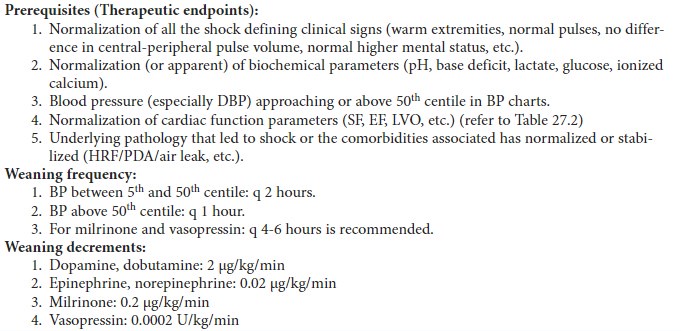
- first in, first out principle should be used in weaning
- if BP more than 75th percentile, faster weaning should be planned
- trophic feeds at 10 to 20 ml/kg/day may be initiated once the therapeutic end points are met